1
/
of
1
GIGABYTE
AORUS SSD GEN4 7300 M.2 PCIE 1TB
AORUS SSD GEN4 7300 M.2 PCIE 1TB
Regular price
£192.38 GBP
Regular price
Sale price
£192.38 GBP
Taxes included.
Shipping calculated at checkout.
Quantity
Couldn't load pickup availability
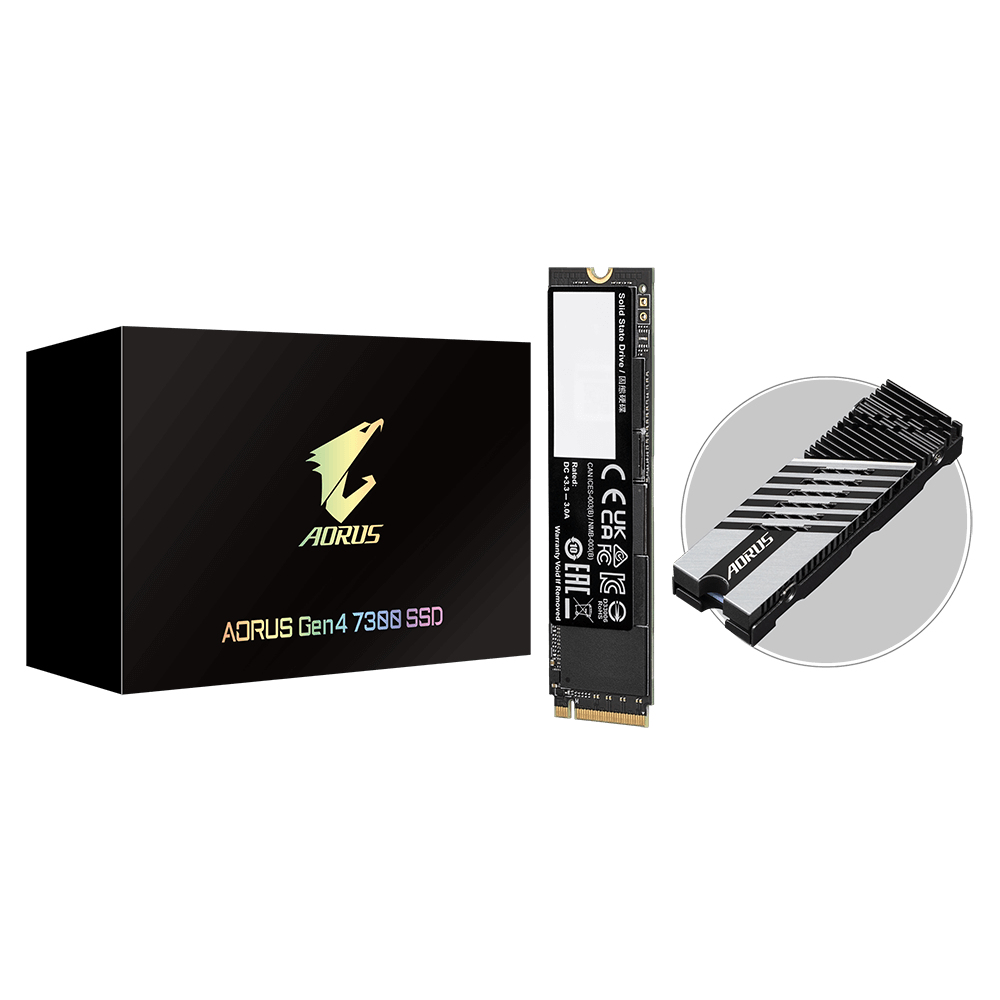
Extremely fast PCIe 4.0 throughput AORUS Gen4 7300 SSD delivers sequential read up to 7.3GB/s with 8 Channel controller- Phison E18- and 3D TLC NAND. The E18 controller is built with the advanced 12nm process ensuring sufficient computing power. Also it supports up to 8 NAND Flash channel with 32CE, DDR4 SLC caching and meets NVMe 1.4. NAND Flash Selected for High Quality and Performance Selected High Speed 3D TLC NAND Flash (1600+ MT/s) The ultra high speed 3D TLC NAND Flash is operating at 1600+ MT/s, which is 50% more than the prevision version that leads to better performance. Xtreme Storage Performance By adopting Phison E18 controller and 3D TLC NAND, AORUS Gen4 7300 SSD delivers blazing speeds: up to 7,300 MB/s for sequential read, and up to 6,000MB/s sequential write. Sequential Read performance of PCIe 4.0 SSDs is 2 times faster than the PCIe 3.0 SSDs. Get ready to enter the next generation of computing with faster and smoother, gaming, streaming, and graphics intensive rendering. Optimized Aluminum Heat Spreaders with Nanocarbon Coating for 20% Cooler Challenged passive cooling to maximize surface area for heat dissipation with advanced thermal technology Nanocarbon coating. Applied with dual side high conductivity thermal pad ensures the heat transferring to the heatsink. The 7mm height heatsink is compatible with all the M.2 slots including the one under graphic card. Efficient Heat Spreader Design Compared with regular heat spreader, the new high efficient heat spreader improves thermal dissipation to extend 46% more time running at high speed. In addition, compared to the one without heatsink, AORUS Gen4 7300 SSD running 5 times longer at 7.3GB/s. Enjoy the smoother & upgraded storage performance. Why is keeping an SSDs at lower temperatures so important? Higher working temperature may cause data loss. The degradation factor of data loss could be a hundred
Share